Bouncy Castle Safety: What to Check Before You Book
The short answer
A bouncy castle hired from a properly run operator is safe when four things are true: it is built to the EN 14960 standard, it carries an in-date PIPA inspection tag, the operator will not run it above a set wind speed, and an adult supervises it the whole time it is inflated. My Party Hire is built around those four checks rather than around review counts or years in business, because they are the things you can actually verify before a child gets on.
My Party Hire is a Reading party equipment hire service. This page sets out the safety standard the industry works to, what the checks actually mean, and the numbers we use to decide when a castle should not be used. Every commitment below is a policy we are building the business around, not a claim about jobs already done.
What makes a hire castle safe? EN 14960 in plain English
EN 14960 is the British and European safety standard for inflatable play equipment. It sets out how a castle has to be built and used: wall height around the bouncing area, the strength of anchor points, how much clear space has to surround the unit, and the maximum number of users at once for its size. It is the standard every commercial inflatable in the UK should be tested against before it is hired out. Every castle we buy for the fleet will be built and tested to EN 14960, and we will list the make, model and safety documentation for each unit on this page once the fleet is live for the 2027 season.
What is PIPA inspection, and does it actually matter?
PIPA stands for the Public Inflatable Play Association. A PIPA inspection is an independent annual check carried out by a qualified inspector, who tests the seams, the anchor points, the blower and the inflation pressure, then attaches a numbered tag to the castle recording the result and the date. You can look up any tag number at pipa.org.uk before you let children on, and a reputable operator will not mind you asking for it. Each unit's PIPA tag number and inspection date will be listed on this page so you can check it before you book, not just on the day, once our fleet is live.
What wind speed is too dangerous for a bouncy castle?
Wind is the single biggest safety factor for an inflatable, because a gust can lift or collapse a castle even when it is pegged down. EN 14960 guidance treats sustained wind above 19mph as the point where a castle should not be inflated. Most operators quote a working limit of 24mph. We stop use at 20mph, which is towards the cautious end of that guidance band.
| Beaufort force | Wind speed | What it looks like outside | Castle status |
|---|---|---|---|
| 0 to 3 | Under 12mph | Calm air to a gentle breeze. Leaves rustle, small flags extend | Safe to run |
| 4 | 13 to 18mph | Moderate breeze. Loose paper and dust lift, small branches sway | Safe to run, check the forecast |
| 5 | 19mph | Fresh breeze. Small trees in leaf begin to sway | Top of the safe band under EN 14960 guidance |
| 5 to 6 | 20 to 24mph | Fresh to strong breeze. Large branches move, an open umbrella is hard to hold | We stop use at 20mph. Some operators run on to 24mph |
| 7 and above | 25mph and above | Near gale and above. Whole trees move, walking into it is hard | Never safe. The castle must be deflated |
You do not need an anemometer to judge this. Treat it as the point to check with your operator if small branches are moving steadily rather than just leaves. Our full weather policy, including what happens to your deposit, is covered on our rain and wind policy page.
Do bouncy castles need constant supervision?
Yes. Every piece of safety guidance for inflatable play, including guidance from the HSE and RoSPA, agrees on this point: a bouncy castle should never be left running unsupervised, even for a few minutes, and children should never be left to organise themselves on it. The adult watching should stand where they can see the whole castle, keep numbers appropriate to its size, and stop children of very different ages or sizes bouncing together at the same time. Smaller units are only rated for a handful of children at once, larger ones for more, and the safe number for your castle will be stated on its booking page once our fleet is live.
What does bouncy castle insurance actually cover?
Public liability insurance covers claims arising from the equipment itself or from how it is delivered and set up. Public liability insurance is for a fault in the castle's build that causes an injury, or something going wrong while we are on site setting up or collecting. It does not cover injuries caused by not following the safety rules while the castle is in your care, for example too many children bouncing at once or nobody supervising. That split is standard across the industry, not something specific to us.
Every castle we send out is covered by public liability insurance to a value of £5 million. Ask two questions when you compare operators: what is your public liability cover, in writing, and who is responsible for supervision during the hire. Both should get you a plain, direct answer.
Anchor points and mats
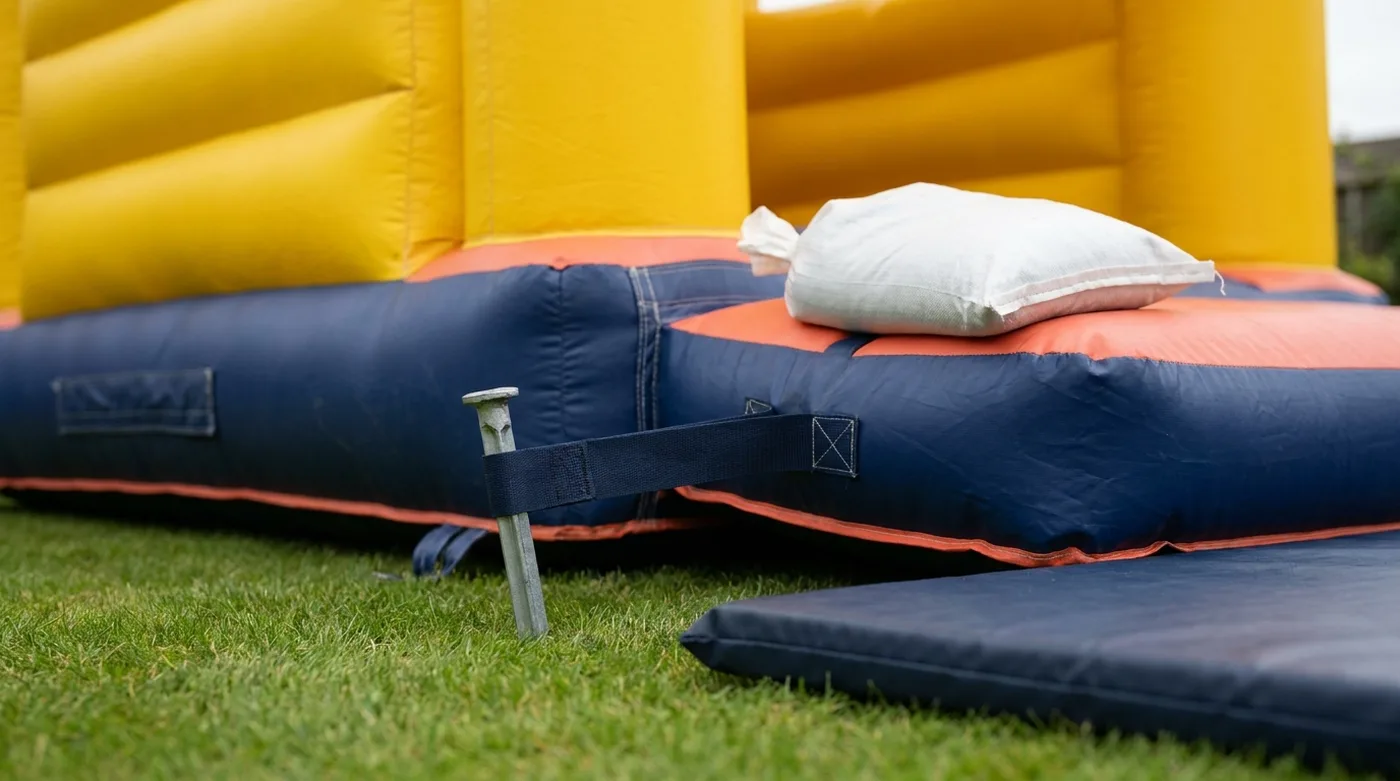
A correctly set up castle is held down with ground anchors, either metal stakes driven into grass or sandbags on a hard surface, at every anchor point the manufacturer specifies, not just the corners. A safety mat should sit across the full width of the entrance to cushion anyone stepping off. It is a fair reason to ask an operator to fix it before children use the castle if they turn up without enough anchor points or without an entrance mat.
Questions people ask before booking
Are bouncy castles actually safe?
Yes, when the operator meets the EN 14960 build standard, keeps the PIPA inspection current, stops use in high wind, and the castle is supervised by an adult throughout. The risk comes from skipping one of those, not from the equipment itself.
What is PIPA inspection and why does it matter?
It is an independent annual safety check that results in a numbered tag on the castle, checkable at pipa.org.uk. It matters because it is the one safety check you can verify yourself before the hire, rather than having to take an operator’s word for it.
What wind speed is too dangerous for a bouncy castle?
Guidance under EN 14960 treats sustained wind above 19mph as unsafe. We stop use at 20mph. See the table above for what that looks like without a wind meter.
Do I need my own insurance to hire a bouncy castle?
No. The operator's public liability insurance covers the equipment and how it is delivered. You do not need a separate policy to hire a castle for a private party.
Can children use a bouncy castle without an adult watching?
No. A castle should never run unsupervised, even briefly. This applies regardless of which operator you book with.
Full pricing, delivery zones and availability for Reading are on our bouncy castle hire Reading page.